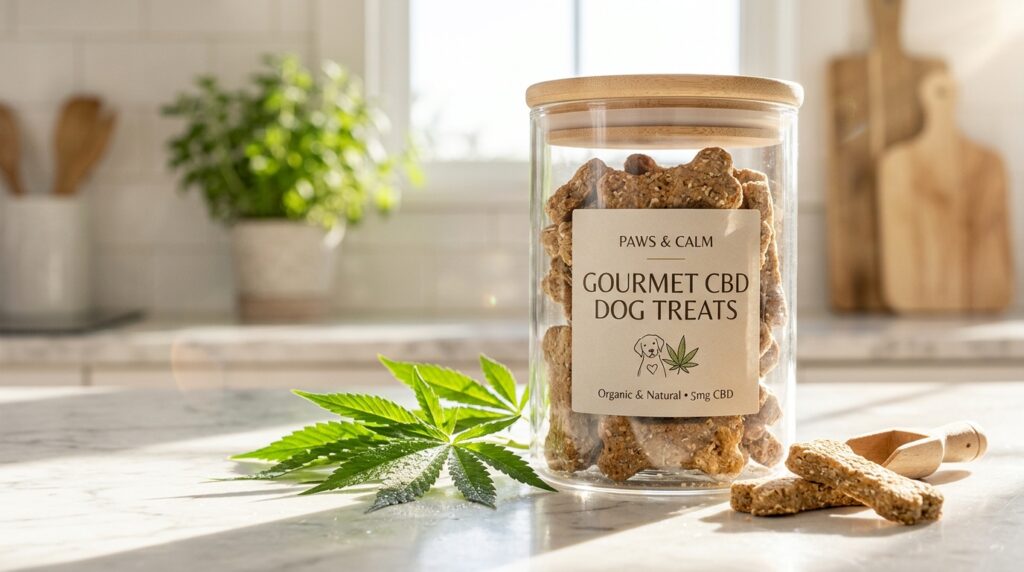
The first firework goes off at 9:40 p.m. A dog that was asleep on the rug is now behind the toilet, panting and shaking. Owners who have lived through that scene tend to remember it clearly.
Noise fear is one of the most common behavior problems in pet dogs, and it drives a large share of the interest in CBD dog treats marketed for calm. Treats are only one possible tool, and the evidence behind them is much smaller than the marketing suggests.
The sections below separate what is known about noise fear, which options have regulatory approval, what research exists on hemp-derived treats, and how to build a routine that does not depend on a single product.
What Noise Fear Looks Like
How Common It Is
A survey of more than 13,000 dogs in Finland, led by Katriina Tiira and published in 2016, found that about one third had some form of noise sensitivity. Fireworks, thunder, and gunshots were the usual triggers. Shelters across the United States commonly report more lost-dog intakes in the days after July 4, since frightened dogs bolt through doors, fences, and open car windows.
The Signs
Owners tend to recognize panting and trembling. Other signs are easier to miss.
- Lip licking, yawning, and a tucked tail
- Pacing, hiding, or pressing against a person
- Drooling, vomiting, or loss of bladder control
- Destroyed doors, window frames, and crates during escape attempts
- Refusing food hours after the noise ends
Fear that escalates with each exposure rarely fixes itself, and a veterinary visit is the first step if signs are strong.
Training First, Treats Second
Veterinary behaviorists generally build a plan around behavior modification. Desensitization means playing a recording of the trigger at a volume so low that the dog stays relaxed, then raising it slowly over weeks. Counterconditioning pairs the sound with something the dog loves, so the trigger starts predicting good things. The work takes time and works best when started months before fireworks season.
Medication has a documented place as well. The FDA approved Sileo, an oral gel containing dexmedetomidine, in 2016 specifically for noise aversion in dogs. Clomipramine (Clomicalm) and fluoxetine (Reconcile) are approved for separation anxiety. A board-certified veterinary behaviorist can match tools to the individual dog, and a general practice veterinarian can handle many cases.
Any hemp treat arrives into that picture as an add-on and not a foundation. A dog that eats a treat but never gets training will usually still be afraid.
What Research Shows on CBD and Anxiety
Controlled research is scarce. One example is a 2020 study in Frontiers in Veterinary Science by Morris and colleagues, which tested CBD-containing treats on dogs exposed to a noise-induced fear test. Studies like it are small, and none has established CBD as a reliable treatment for canine anxiety.
Most of the claims on pet product pages come from owner testimonials, which carry problems. Owners often judge calm by what they expect to see, and a dog may also settle down because of the novelty of a treat. Blinded, placebo-controlled trials exist to filter out those effects.
Dosing is a second gap. Treat labels list a few milligrams of CBD per piece, and no agreed dose exists for fear or anxiety in dogs. The FDA has not approved any CBD product for animals, and the agency has said it cannot vouch for the safety or effectiveness of products sold for them.
Building a Calm Routine
A schedule helps more than any single ingredient. This outline works for predictable events such as July 4 or New Year’s Eve.
| When | What to do |
|---|---|
| Weeks before | Start sound desensitization, book a vet visit if signs are strong, confirm the microchip and tag details |
| Days before | Set up a quiet room with a crate or bed, white noise, and closed curtains |
| Day of | Exercise the dog earlier in the day, feed a normal meal, keep the dog indoors |
| During | Stay calm, offer favorite chews, play steady background sound |
| After | Let the dog settle on its own schedule, then return to normal routine |
Where a CBD treat is added, the timing should follow the veterinarian’s direction. Trying a product for the first time on the night of the fireworks makes results hard to read. Testing it on a quiet day shows whether the dog tolerates it, whether it causes drowsiness or an upset stomach, and how long the effects last.
Safety Boundaries
- THC is the main hazard in full-spectrum products. Dogs are more sensitive to it than people, and signs include wobbling, drooling, vomiting, and urine dribbling.
- Sedation can mask fear without lowering it. A dog that seems calm may still be anxious and unable to move.
- A lab certificate of analysis should match the batch on the bag, with THC and contaminants listed.
- Dogs on other sedatives or anxiety medication should not receive hemp products without veterinary approval.
- The bag should be stored out of reach. Dogs have eaten entire packages of treats.
- Escape risk stays high. Collars with tags, microchips, and secure doors matter more than any supplement.
Short FAQ
Can CBD treats be given right before fireworks?
No standard timing exists. A veterinarian can advise based on the product and the dog.
Will a treat stop the fear completely?
Evidence does not support that. Training and approved medication have a stronger record.
Are there side effects?
Drowsiness, loose stools, and raised liver enzymes have appeared in dog studies of CBD.
Is separation anxiety handled the same way?
Separation anxiety usually needs a behavior plan and sometimes medication, and a veterinarian should assess it.
Final Thoughts
Noise fear responds best to training, a prepared space, and veterinary guidance, with any hemp treat as a minor extra. A tested product and a tested routine matter more than a single calming claim.